
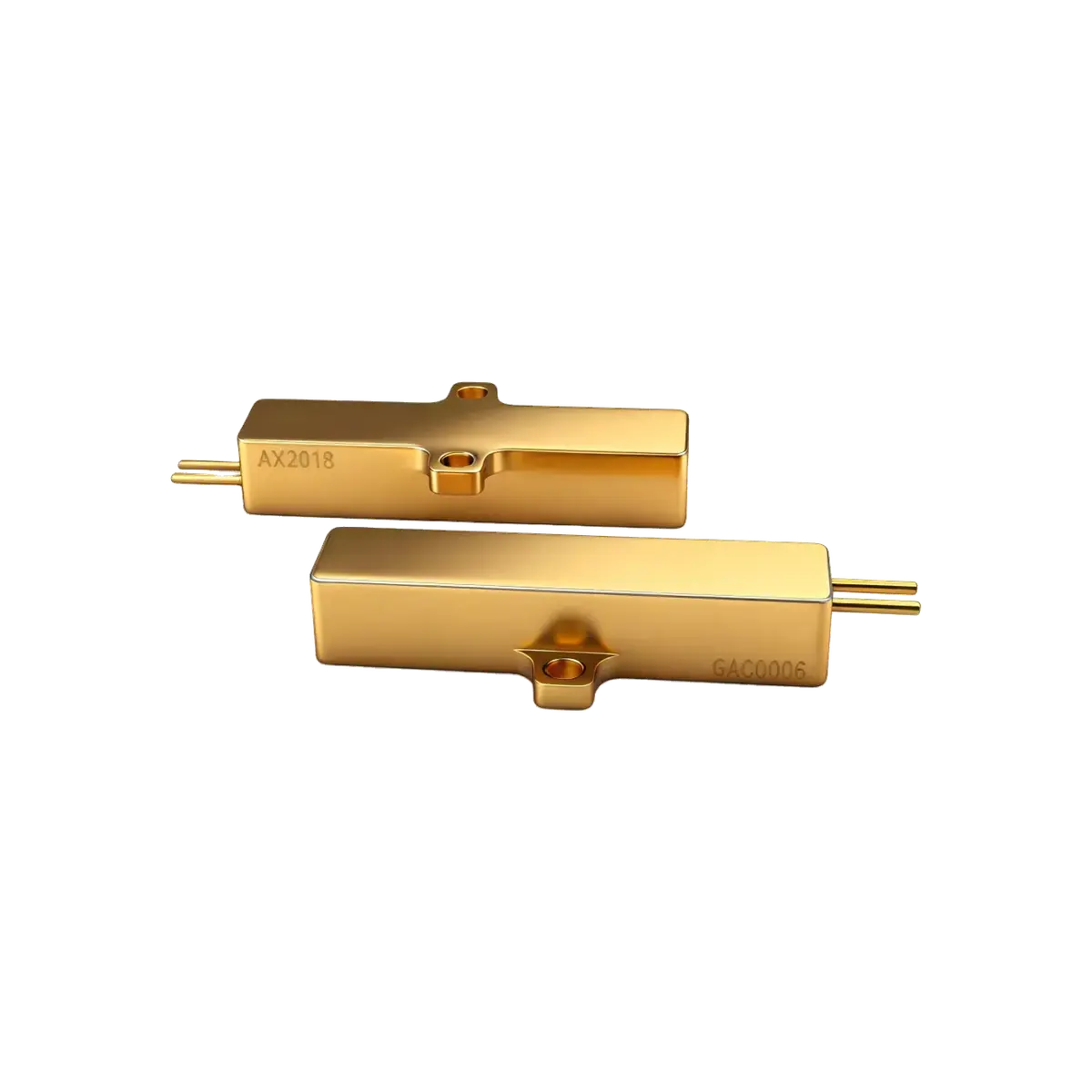
Search for an “erbium laser” and you will find two completely different machines: a clinic device that removes the top layer of skin, and a compact module inside a rangefinder or LiDAR head. Both contain erbium. Neither can do the other's job.
This page explains the difference in plain engineering terms — which crystal emits which wavelength, why the 2940 nm Er:YAG laser is not a ranging source, and why the 1535 nm erbium glass (Er:Yb) laser is the one that ends up in laser rangefinders, LiDAR, and eye-safe designators. If you are comparing 1535 nm with 905 nm instead, that comparison is here.
Three lasers that all get called “erbium”
The word describes a dopant, not a wavelength. The host material decides the rest.
| Property | Er:YAG | Er:Yb glass | Nd:YAG (for contrast) |
|---|---|---|---|
| Wavelength | 2940 nm | 1535 nm | 1064 nm |
| Gain medium | Er³⁺ doped YAG crystal | Er³⁺/Yb³⁺ co-doped phosphate glass | Nd³⁺ doped YAG crystal |
| Pumping | Usually flashlamp, sometimes 1470 nm in-band | 940–976 nm diode, absorbed by Yb³⁺ and transferred to Er³⁺ | 808 nm diode |
| Repetition rate | Single shot up to tens of Hz | 1 Hz to 5 kHz | Up to several kHz |
| What it is used for | Skin resurfacing, dentistry, surgery | Laser rangefinding, LiDAR, eye-safe designators, sensing | Marking, cutting, some ranging and medical systems |
What Er:YAG at 2940 nm is actually for
2.94 µm sits on one of water's strongest absorption bands. In tissue, that means the energy is deposited within roughly a micrometre of the surface — which is exactly what a dermatologist or a dental surgeon wants: controlled ablation with minimal heating of the material below. Er:YAG is a good tool for that job, and it has been for thirty years.
For a ranging programme, the same property becomes a liability. The beam is attenuated by atmospheric water vapour, the gain medium is normally flashlamp-pumped (low repetition rate, low wall-plug efficiency, lamp life to manage), and the detectors and coatings for 2.94 µm are a small, expensive niche compared with what exists at 1.5 µm.
Why 2940 nm is not a ranging source
- Atmosphere: 2.94 µm is absorbed by water vapour in the air. Over kilometres, the transmitted energy that survives is a fraction of what leaves the aperture.
- Rate: flashlamp pumping caps repetition rate at tens of hertz and adds thermal load that a compact payload cannot carry.
- Detection: 1.5 µm has mature, inexpensive InGaAs detectors; 2.94 µm does not. The receiver is usually the limiting factor in a rangefinder, and this one is hard to build.
- No eye-safety advantage: 2.94 µm is absorbed by the cornea as well. It buys nothing on the safety side that matters for a fielded system.
What Er:Yb glass at 1535 nm is for
Erbium–ytterbium co-doped phosphate glass lases around 1535 nm. The Yb³⁺ absorbs the 940–976 nm pump and hands the energy to Er³⁺; the glass host allows high doping in a small volume, which is what makes the microchip package possible. The result is a diode-pumped, passively Q-switched source that fits in tens of cubic millimetres and still delivers tens of microjoules to ten millijoules per pulse.
Those are the numbers a rangefinder or a LiDAR head needs: 10 µJ to 10 mJ of pulse energy, 3.5 ns to 13 ns pulse widths, and repetition rates from 1 Hz up to 5 kHz. The trade-off between energy per pulse and rate is real, and it is the reason our range splits into three families — described in how to choose pulse energy and summarised on the Laser Sources page.
Why 1535 nm is called “eye-safe”
Between roughly 1.4 µm and 2.0 µm, the eye behaves differently: the cornea absorbs the light before it reaches the retina. A 1535 nm pulse can therefore be Class 1 under IEC 60825-1 at energies that would be hazardous at 905 nm or 1064 nm. That is the whole reason the 1.5 µm band is used in handheld rangefinders, UAV payloads and anything that might be pointed near people. It does not mean “no precautions” — the optics and the beam path still need to be evaluated.
So which one do you need?
If the requirement is to remove tissue, shape a surface, or drill — Er:YAG at 2940 nm is the right family, and the supplier will be a medical laser company. If the requirement is to measure distance, build a point cloud, or designate a target at ranges from metres to tens of kilometres, the 1535 nm erbium glass laser is the family that fits, and the parameters to fix first are pulse energy, repetition rate, beam divergence and package size.
A practical way to start: describe the target range, the target reflectivity, the measurements per second the system must sustain, the aperture you can afford, and the mass budget. From those five numbers the model usually falls out of the table on the Laser Sources page — our engineering team can do that narrowing with you, including OEM or ODM work when no standard model fits.
Frequently asked
Is an Er:YAG laser the same as an erbium glass laser?
No. Both use erbium ions, but Er:YAG is a crystal that emits at 2940 nm, while erbium glass is an Er³⁺/Yb³⁺ co-doped glass that emits around 1535 nm. Different wavelength, different pumping, different applications.
What wavelength is an “erbium laser”?
It depends on the host. Er:YAG is 2940 nm, erbium glass is about 1535 nm, and erbium-doped fibre amplifiers — the other common use of erbium — work around 1550 nm. The 1535 nm band is the one used for eye-safe ranging.
Can Er:YAG be used for LiDAR or rangefinding?
Not practically. Atmospheric water vapour attenuates 2.94 µm, flashlamp pumping limits repetition rate, and detectors for that band are scarce and costly. For ranging, 1535 nm is the better-matched erbium source.
Why do rangefinders use 1535 nm instead of 1064 nm or 905 nm?
Eye safety at useful energies, good atmospheric transmission, and mature InGaAs detection at 1.5 µm. The trade-off is detector cost and, at very long range, the energy available per pulse — which is what the larger models in the Laser Sources range address.
If you are specifying a 1535 nm source — or comparing it with a 2940 nm or 1064 nm option from another supplier — send us the requirement. Datasheets, outline drawings and 3D models for all sixteen models are published on this site, and the wavelength and gain-medium background sits in the engineering resources.