

ER800 1535nm 800µJ Eye-Safe Laser for Multi-Kilometer LiDAR and Rangefinders
PRODUCT OVERVIEW
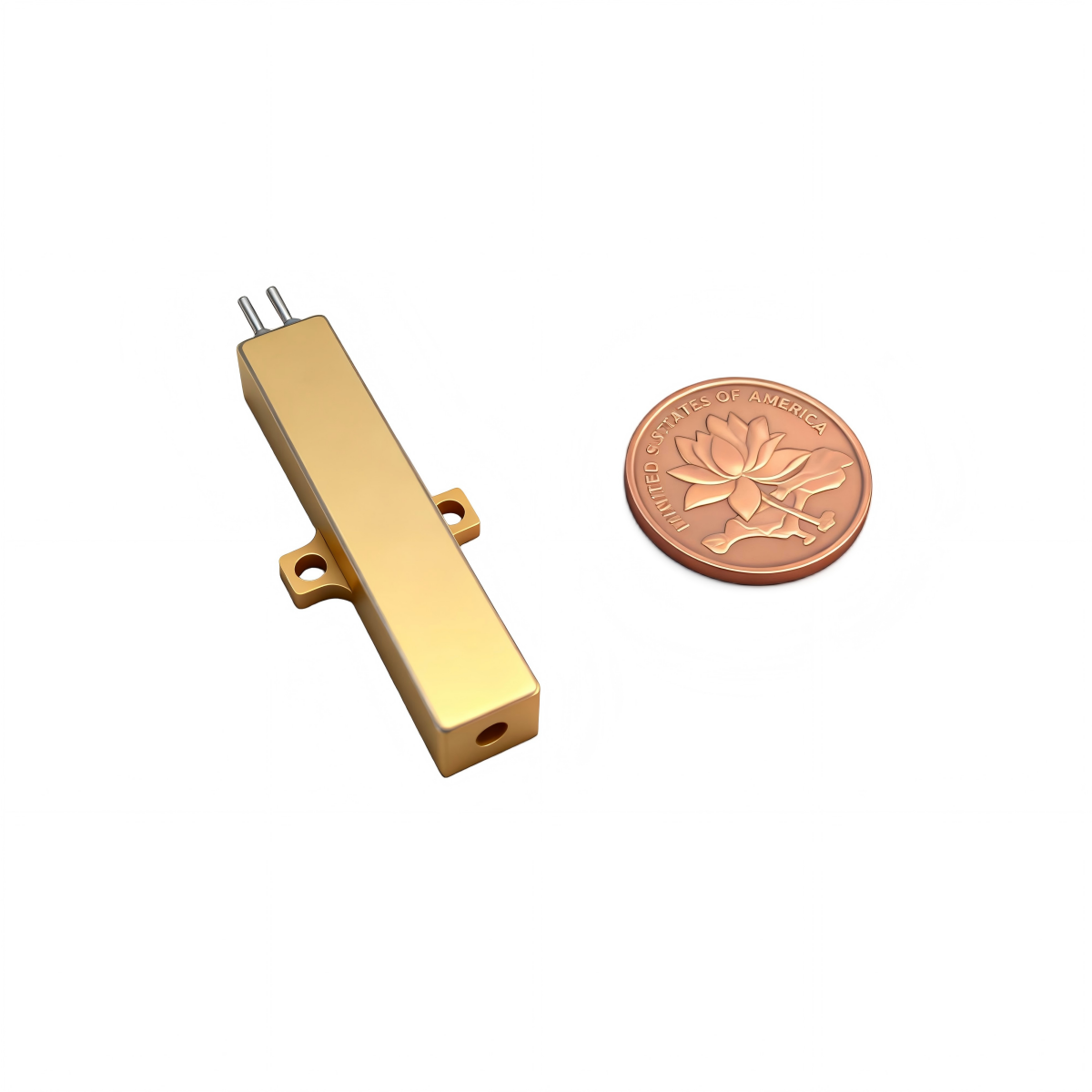
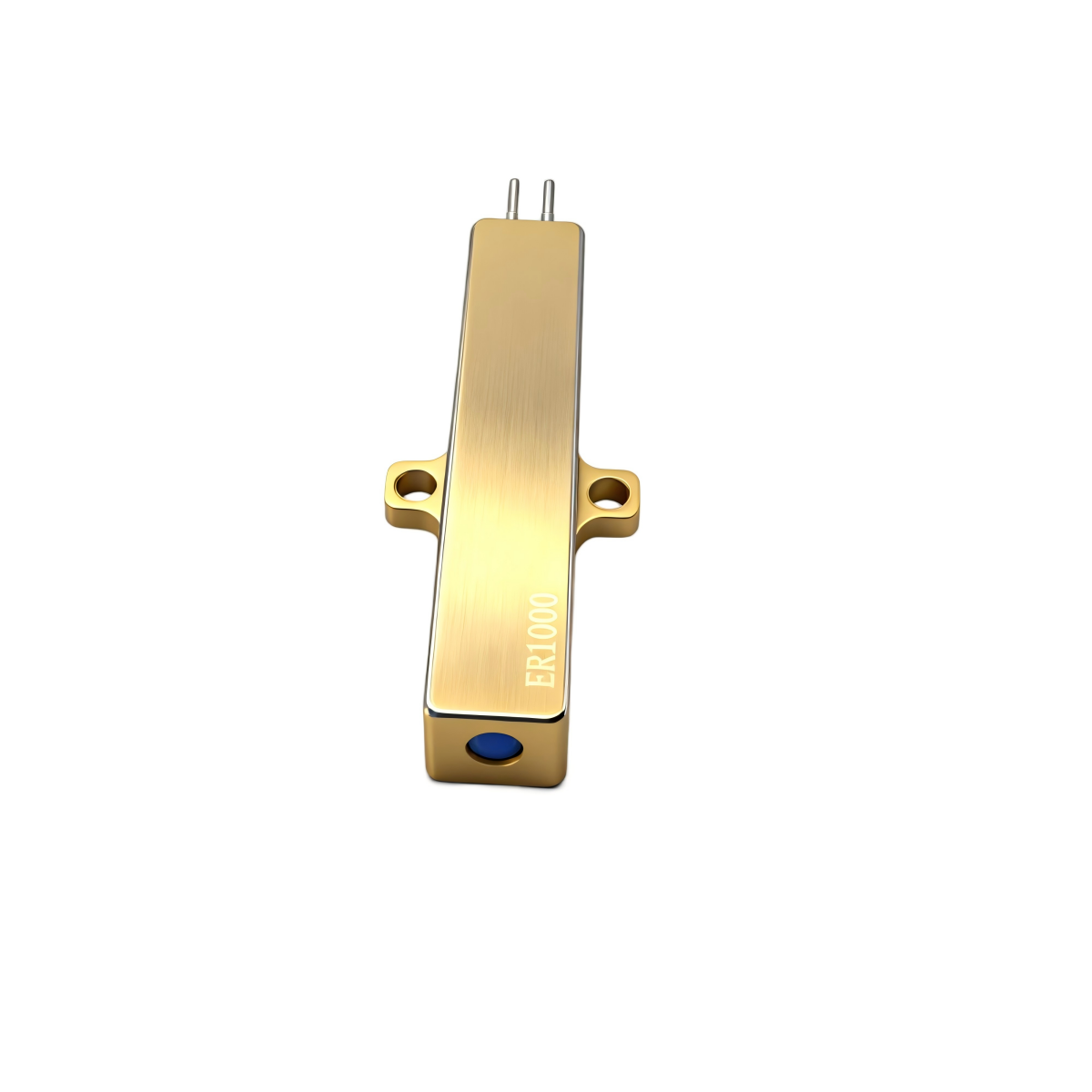
ER800 is a compact 1535 nm pulsed laser source based on Er:Yb glass microchip technology, designed for multi-kilometer LiDAR and rangefinders.
- Pulse energy
- ≥800 µJ
- Repetition rate
- 1~10Hz
- Pulse width
- 7 ns
- Dimensions
- 40×8×7.5mm3
- Weight
- 18 g
KEY FEATURES
- ✔ 1535 nm Eye-Safe Operation (Class 1)
- ✔ 800µJ Pulse Energy
- ✔ Compact OEM Design
- ✔ High Pulse Stability
- ✔ Long Lifetime
Optical Specifications
| Wavelength | 1535 nm |
|---|---|
| Pulse Energy | ≥800 µJ |
| Pulse Width | 7 ns |
| Beam Quality | TEM00 |
| Operation | Pulsed |
| Lifetime | ≥1 million shots |
| Drive pulse width | ≤ 3 ms |
| Pulse repetition rate | 1~10Hz |
| Pulse stability | 10% |
| Raw Beam Diameter | 0 .3 mm |
| Beam divergence angle | ≤ 7 mrad |
Mechanical and Environmental Specifications
| Operating temperature | -40 ℃ ~ +65 ℃ |
|---|---|
| Storage temperature | -55 ℃ ~+ 75℃ |
| Dimension (mm) | 40×8×7.5mm3 |
| Weight | 18 g |
| Voltage | 2 V |
| Electric current | 30 A |
| Shock | 1500 G, 0.5 ms |
| Vibration | 20~2000 Hz/20 G |
Integration Considerations
Review package constraints, electrical requirements and thermal conditions before integration. The driver supply must be matched to the specified voltage and current, and the drive pulse width must remain within the stated limit. For application-specific questions, contact our engineering team with your system requirements.
APPLICATIONS




DOWNLOADS
- Datasheet (PDF)
- 3D model (GLB) — open in any 3D viewer or CAD tool
- Outline drawing (STEP) — request from our team
- Integration guide — request from our team
Product Description
ER800 1.54µm / 1535nm 800µJ Eye-Safe Erbium Glass Microchip DPSS Laser
The ER800 is a high-energy 1535nm eye-safe erbium glass microchip DPSS laser designed as a compact transmitter core for multi-kilometer LiDAR, laser rangefinders and target-designation modules. It uses an LD-pumped erbium-doped glass gain medium in a microchip resonator to generate nanosecond pulses in a slim, board-level package that is easy to embed in airborne, vehicle and tripod-mounted systems.
The ER800 delivers pulse energy of ≥800µJ with a typical pulse width of 7ns and a repetition rate adjustable from 1 to 10Hz. Pulse stability is specified at 10%, supporting consistent echo returns for time-of-flight ranging and point-cloud acquisition. The raw beam diameter is about 0.3mm, the beam divergence is ≤7mrad, and the mode is TEM₀₀, which makes it straightforward to collimate for long-distance propagation or couple into compact transmit optics.
Mechanically, the laser is housed in a 40×8×7.5mm³ module and weighs approximately 18g, giving system designers a high-energy 1.54µm source without sacrificing space in tightly packed rangefinder or LiDAR electronics. Electrically, the typical load voltage is <2V with a drive current of 30A, drive pulse width ≤3ms and repetition rate up to 10Hz. The ER800 is intended to be driven by a constant-current source; the driver power supply must be properly matched to these parameters, otherwise the laser may fail to operate correctly or could be overloaded and permanently damaged.
To ensure reliability in harsh conditions, the ER800 is specified for −40°C to +65°C operating temperature and −55°C to +75°C storage temperature. It withstands 1500G shock with 0.5ms duration and 20–2000Hz vibration at 20G, and the lifetime exceeds 1 million shots, matching the requirements of long-life LiDAR and laser rangefinding platforms.
Operation guidelines emphasize safe connection and proper parameter configuration. Power must be switched off and fully isolated before wiring; the positive and negative terminals should be carefully checked, and all contacts must be firmly secured to avoid short circuits, reversed polarity and intermittent connections. After confirming correct wiring, the driver parameters—voltage, current, pulse width and repetition rate—should be set according to the attached factory test report before turning on the driver so that the laser operates within its specified window. The output window must be kept clean and should not be touched; if contamination is present, it must be cleaned before operation. When fastening the module via the mounting lugs, a torque of about 0.2 N·m is recommended to maintain mechanical stability without distorting the housing.
At 1.5µm, the ER800 works in an eye-safer band where radiation is strongly absorbed by the cornea and lens instead of directly reaching the retina, significantly reducing retinal risk and making it suitable for open, man-in-the-loop environments. Combined with low atmospheric attenuation and good penetration in fog, rain and aerosol, this makes the ER800 particularly well suited for long-range laser rangefinders, UAV and airborne LiDAR payloads, naval and vehicle-borne EO/IR heads, as well as industrial mapping, structural monitoring and robotic perception systems that require multi-kilometer performance with high single-pulse energy.
OUTLINE DIMENSION

Figure 1 Outline Dimensions(mm)
Operating Instructions
-
Match the laser driver to the ER800 laser.
The laser driver power supply must be properly matched to the laser.
The typical load voltage of the ER800 is < 2 V, with an operating current of 30 A, pulse width < 3 ms, and a repetition rate of 10 Hz. The ER800 is designed to be driven by a constant-current source. For the exact operating parameters, please refer to the attached factory test report.
The laser driver power supply must meet these requirements; otherwise, the laser may fail to operate properly or could be overloaded and permanently damaged. Therefore, before wiring, carefully check the laser specification sheet and confirm that the laser is compatible with the selected driver. -
Always disconnect power before wiring.
Before making any connections, make sure the power is switched off and completely isolated. During wiring, carefully check the positive and negative terminals of the laser and ensure correct polarity. After the wiring is completed, perform a thorough inspection to confirm that all connections are correct, in order to avoid short circuits, reverse polarity, and other faults. At the same time, make sure all terminals are firmly secured to prevent poor contact due to loose wiring. -
Set operating parameters according to the factory test report.
After confirming that the wiring is correct, set the corresponding parameters on the driver according to the attached factory test report. Once the parameters are correctly set, turn on the driver; the laser can then operate normally. -
Keep the laser output window clean.
Take care to keep the laser output window clean and do not touch the window surface. If contamination occurs, clean the window thoroughly before operating the laser. -
Use the correct mounting torque.
Because the overall length of the laser housing is relatively long, when fastening the laser via the mounting lugs on both sides, use a torque screwdriver set to 0.2 N·m. Excessive or insufficient torque may affect the mechanical stability and performance of the laser.
Product FAQ
- Is this an eye-safe source?
Class 1 eye-safe at the specified 1535 nm wavelength. - What is the typical use?
Rangefinding, LiDAR, sensing and OEM instrument integration. - Can the package be customised?
See OEM / ODM for the customisation scope and review process.
Interactive 3D Model
Drag to rotate, scroll to zoom. The controlled STEP source is available on request for design release.
ER800